Wolfgang Amadeus Mozart: Violin Concerto No. 3 in G Major, K. 216
Sergei Prokofiev: Symphony No. 6 in E flat Minor, Op. 111
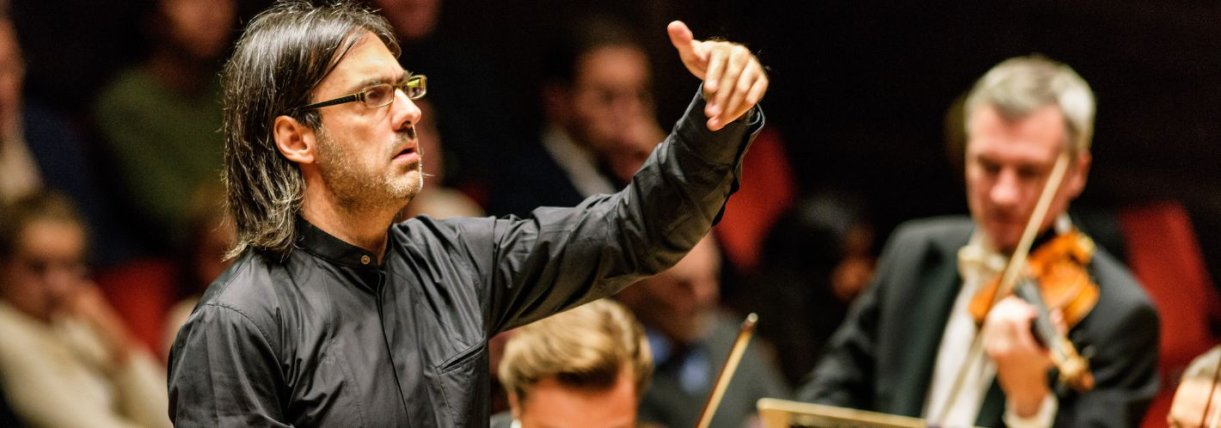
Bringing Mozart to Prague may seem like bringing sand to the beach. However, Greek violinist and conductor Leonidas Kavakos convinces even experts that it is possible to discover new aspects of well-known music. A lucid, urbane Mozartian, as he is described by the British magazine Gramophone, Kavakos will perform Violin Concerto No. 3 with his gracefully elegant sound while also conducting the entire performance with his Stradivarius in his hands. This was common practice during the era in which Mozart stayed in Prague and his performances were received enthusiastically. Kavakos will also conduct Sergei Prokofiev’s Symphony No. 6, this time without his violin. The symphony’s elegant music with a slight intrinsic melancholy seems to shake hands with Mozart across the centuries. It is hard to believe that the symphony’s universal lucidity was a thorn in the side of communist reviewers: on the instructions of the Stalinist authorities, even those who had ardently praised it a few days earlier rejected it. Its beautiful music will allow all to mercifully forget these injustices while remembering them well at the same time.
Named Gramophone’s Orchestra of the Year in 2024, the Czech Philharmonic is recognised as one of the world’s leading orchestras and remains the Czech Republic’s key cultural ambassador. Now in its 131st season, the orchestra combines a deep-rooted musical tradition with an international artistic outlook, expanding its profile through tours, residencies and recordings.
During the 2024 Year of Czech Music, the Czech Philharmonic and its Chief Conductor and Music Director Semyon Bychkov gave a three-day residency at New York’s Carnegie Hall. That same year saw the release of their recording of Smetana’s Má vlast (My Country), which went onto win the 2025 BBC Music Magazine Orchestral Award. In addition to Czech music, the orchestra’s long-standing relationship with composers such as Brahms, Tchaikovsky and Mahler has resulted in a series of benchmark recordings, including The Tchaikovsky Project (2019) and the first new cycle of Mahler symphonies in more than 40 years, released in 2026. The next release with Bychkov features Shostakovich’s Symphony Nos. 5 and 7.
The 131st season opens in Prague with Shostakovich’s Violin Concerto No. 1 featuring Artist-in-Residence Janine Jansen, alongside Dvořák’s Symphony No. 7. Touring highlights include the orchestra’s first visit in over 50 years to Sweden and Finland, a return to Lucerne Festival, and residencies in London, Vienna and Hamburg. At home, the Czech Philharmonic performs at the Rudolfinum in Prague and at leading Czech festivals including Dvořák Prague, Prague Spring, Smetana Litomyšl, and for the first time, Janáček Brno.
Repertoire this season with Bychkov includes Má vlast; works by Mussorgsky, Ravel, Adams, Strauss, Glanert and Britten; and a major focus on Rachmaninoff, presented both in Prague and on tour. Beethoven’s Ninth Symphony, performed with the Prague Philharmonic Choir, will mark the 200th anniversary of the composer’s death in 2027.
Principal Guest Conductors Simon Rattle and Jakub Hrůša both return this season. With Rattle, the orchestra presents music by Barber, Shostakovich, Debussy, Szymanowski and the Czech premiere of Composer-in-Residence Thomas Adès’s Aquifer. With Hrůša – appointed last year as the orchestra’s next Chief Conductor and Music Director (Renáta Kellnerová Chair) from the 2028/2029 season – they perform works by Strauss, Beethoven, Suk and a world premiere by Martin Smolka.
Guest conductors this season include Vasily Petrenko, Herbert Blomstedt, Elim Chan, Maxim Emilyanchev, and Daniel Harding, who closes the subscription season with the Accademia Nazionale di Santa Cecilia. Guest soloists include Yuja Wang, Behzod Abduraimov, Mao Fujita, Yunchan Lim, Seong-Jin Cho, Karen Gomyo, Radek Baborák and Kirill Gerstein.
The Czech Philharmonic’s distinguished history reflects the Czech Republic’s complex political past and its central European location. An early champion of the music of Martinů and Janáček, the Czech Philharmonic gave its first concert in 1896 with an all-Dvořák programme conducted by the composer itself.
Alongside its commitment to championing Czech composers, the orchestra’s belief in the power of music to transform lives remains a defining principle. The Czech Philharmonic Youth Orchestra, Orchestral Academy, and Jiří Bělohlávek Prize for young musicians, form part of the orchestra’s education strategy which engages with more than 400 schools. An inspirational music and song programme led by Ida Kelarová continues to support social inclusion by giving voice to Romany communities through music.
source: Česká filharmonie
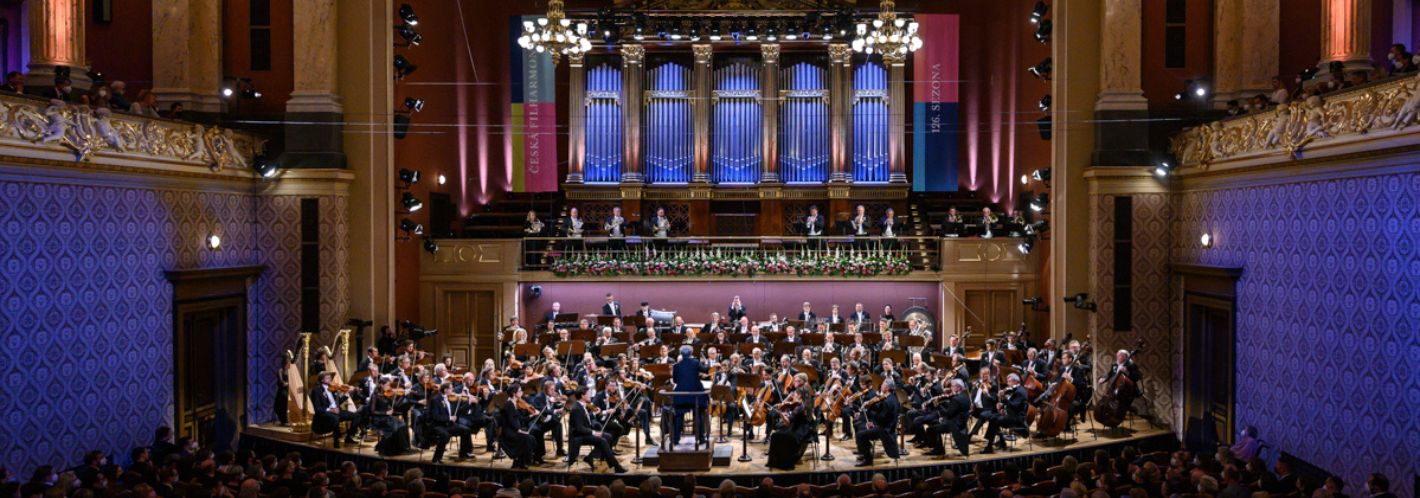
Leonidas Kavakos is recognized across the world as a violinist and artist of rare quality, acclaimed for his matchless technique, his captivating artistry and his superb musicianship, and the integrity of his playing. Kavakos works regularly with the world’s greatest orchestras and conductors and appears in recital at the world’s premier recital halls and festivals. In recent years, Kavakos has built a strong profile as a conductor and has conducted such orchestras as the New York Philharmonic, Bavarian Radio Symphony Orchestra, Dallas Symphony, Vienna Symphony, Orchestre Philharmonique de Radio France and the Filarmonica della Scala.
Kavakos is an exclusive recording artist with Sony Classics. Releases have included the Beethoven Violin Concerto which he conducted and played with the Bavarian Radio Symphony Orchestra, and the re-release of his 2007 recording of the complete Beethoven Sonatas with Enrico Pace, for which he was named ECHO Klassik Instrumentalist of the year. In 2022 Kavakos released Beethoven for Three: Symphony No. 6 “Pastorale” and Op.1, No. 3 arranged for trio, with regular recital partners Emanuel Ax and Yo-Yo Ma. Further albums from this series containing arrangements of Beethoven symphonies will be released in coming years. With his chamber group the ApollΩn Ensemble, he recently released Bach: Violin Concertos to critical acclaim. Kavakos was named Gramophone Artist of the Year.
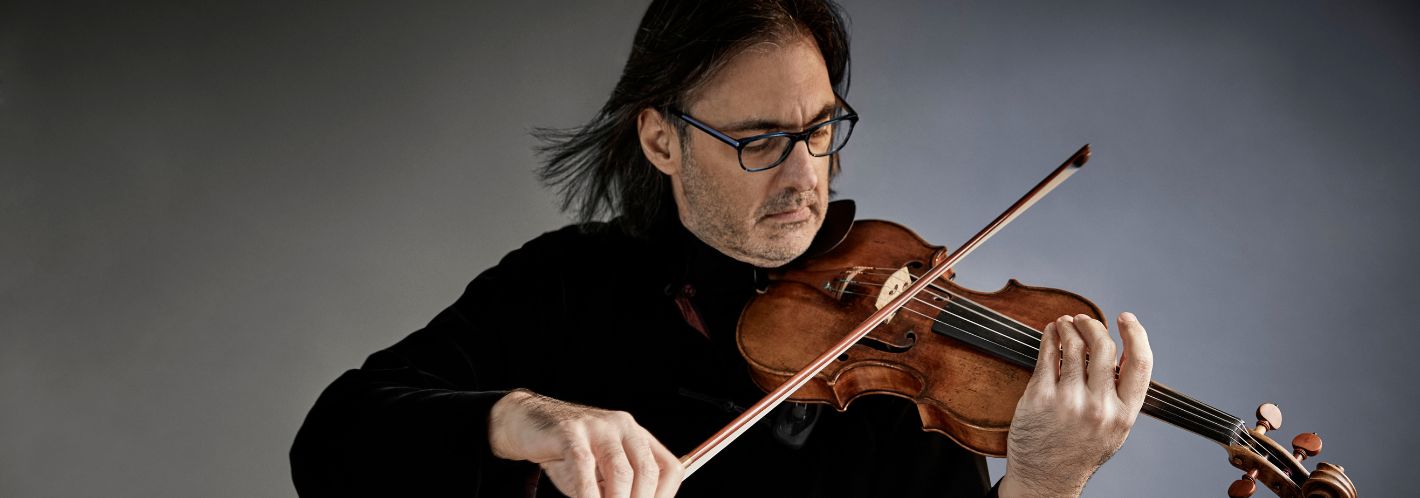
Born into a musical family in Athens, Kavakos curates an annual violin and chamber music masterclass in Athens, which attracts violinists and ensembles from all over the world. In 2022, he was declared a regular member of the Chair of Music in the Second Class of Letters and Fine Arts for his services to music. Kavakos plays the “Willemotte” Stradivarius violin of 1734.
source: Intermusica
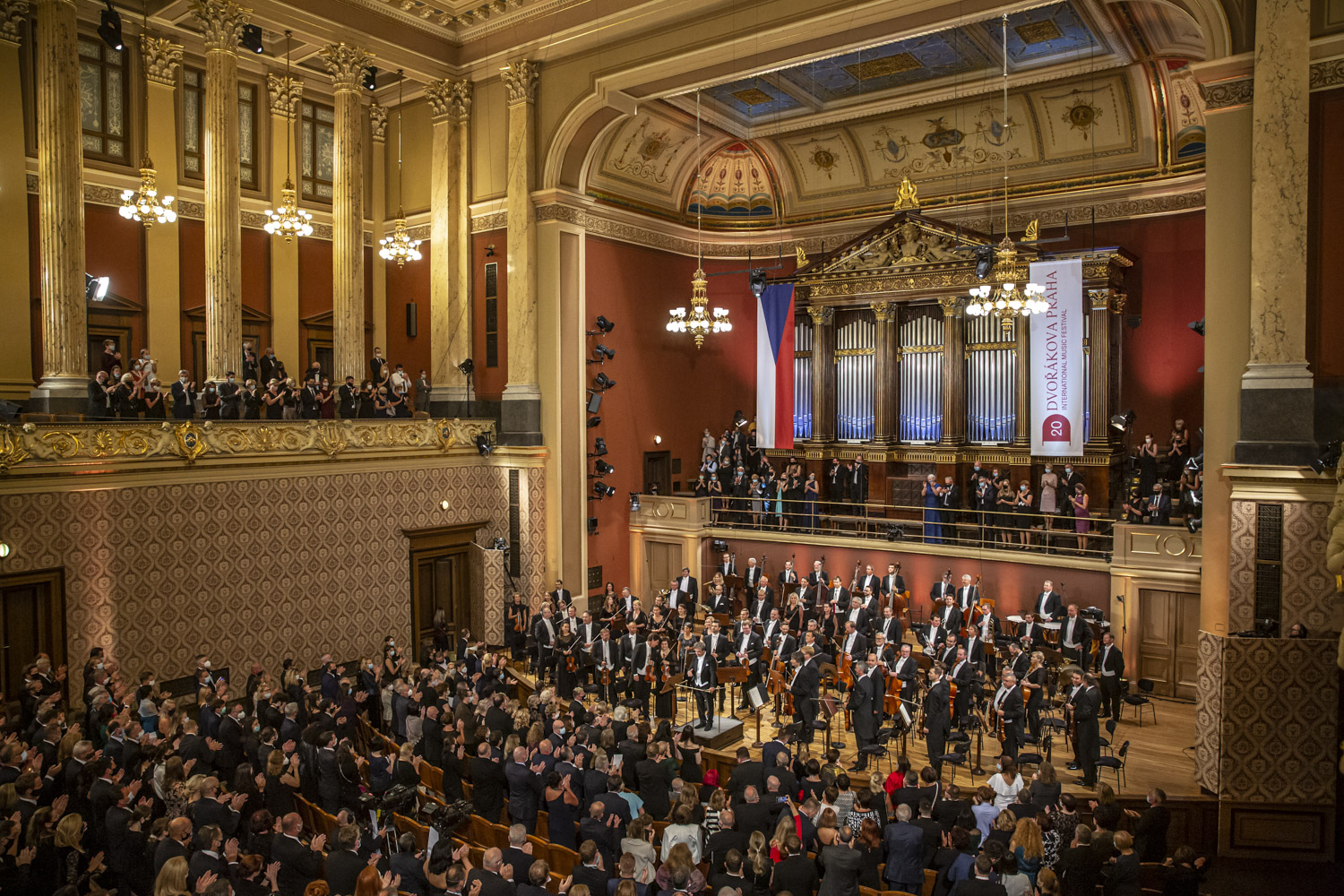
The Rudolfinum is one of the most important Neo-Renaissance edifices in the Czech Republic. In its conception as a multi-purpose cultural centre it was quite unique in Europe at the time of its construction. Based on a joint design by two outstanding Czech architects, Josef Zítek and Josef Schultz, a magnificent building was erected serving for concerts, as a gallery, and as a museum. The grand opening on 7 February 1885 was attended by Crown Prince Rudolph of Austria, in whose honour the structure was named. In 1896 the very first concert of the Czech Philharmonic Orchestra took place in the Rudolfinum's main concert hall, under the baton of the composer Antonín Dvořák whose name was later bestowed on the hall.