Johann Sebastian Bach: Piano Concerto No. 1 in D Minor, BWV 1052
Wolfgang Amadeus Mozart: Piano Concerto No. 27 in B flat Major, K. 595
Ludwig van Beethoven: Symphony No. 3 in E flat Major, Op. 55 ‘Eroica’
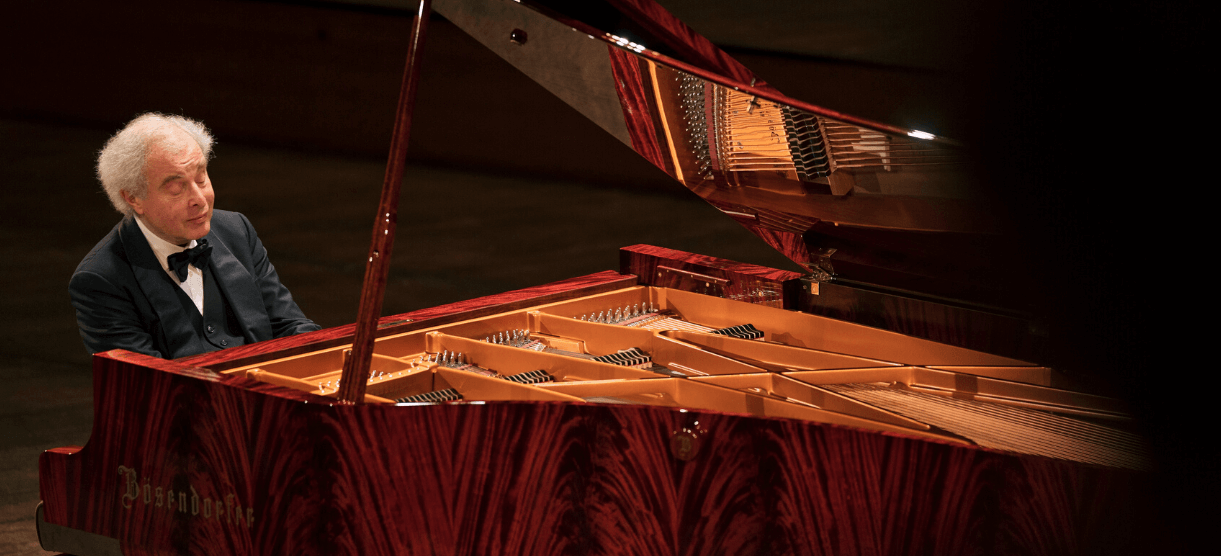
Pianist András Schiff starts each day with a rendition of Bach, and in his own words, it is different every time. Piano Concerto No. 1 in D Minor by Johann Sebastian Bach will be the first piece performed at the concert by this originally Hungarian virtuoso. As well as playing the piano, he will be conducting the Czech Philharmonic.
For quite some time now, Sir András Schiff has needed no introduction among the music-loving public. Two years ago, as the Dvořák Prague festival’s Artist-in-Residence, he enthralled audiences as a pianist and conductor of the first Czech orchestra. However, his performance this year, despite having the same line-up, will be different – just as Bach’s music is different each time it is played . Over the course of one evening, he will perform two piano concertos: Bach’s Piano Concerto No. 1 and Mozart’s Concerto No. 27 in B flat Major. To conclude the evening, he will be conducting Beethoven’s Symphony No. 3 in E flat Major, as known as the Eroica.
Schiff argues that music and politics are inextricably linked, even though these pieces were written by composers who have long been dead. The heroic symphony begins with a military fanfare motif, reminiscent of a call to arms. However, the funeral march in the second movement serves to reminds us that an egoistic obsession with unlimited power can also lead to great downfalls.
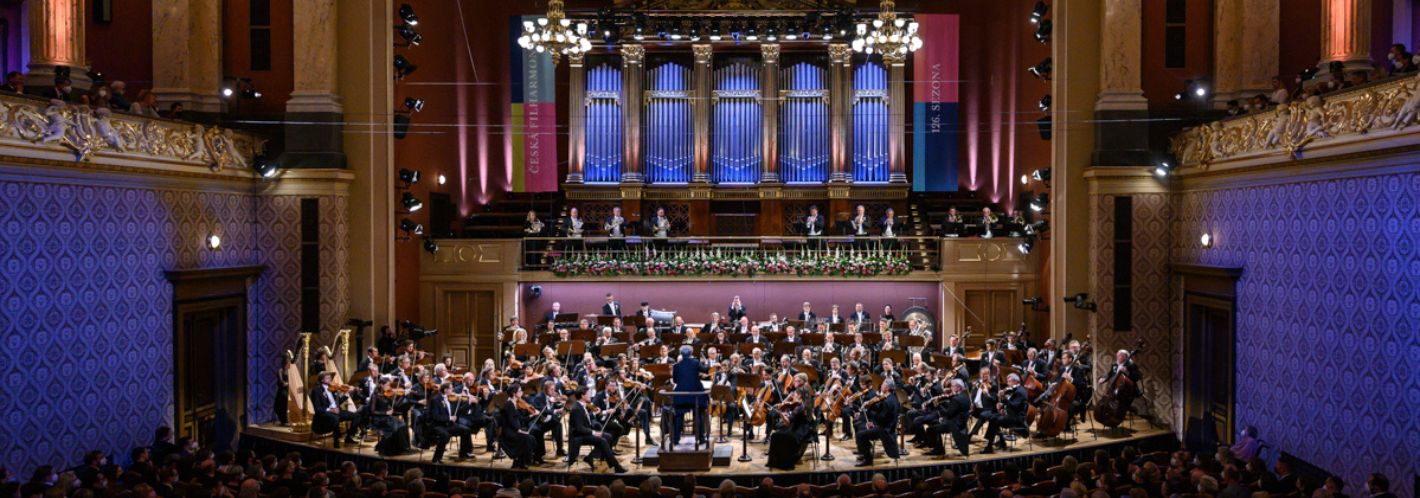
Named Gramophone’s Orchestra of the Year in 2024, the Czech Philharmonic is recognised as one of the world’s leading orchestras and remains the Czech Republic’s key cultural ambassador. Now in its 131st season, the orchestra combines a deep-rooted musical tradition with an international artistic outlook, expanding its profile through tours, residencies and recordings.
During the 2024 Year of Czech Music, the Czech Philharmonic and its Chief Conductor and Music Director Semyon Bychkov gave a three-day residency at New York’s Carnegie Hall. That same year saw the release of their recording of Smetana’s Má vlast (My Country), which went onto win the 2025 BBC Music Magazine Orchestral Award. In addition to Czech music, the orchestra’s long-standing relationship with composers such as Brahms, Tchaikovsky and Mahler has resulted in a series of benchmark recordings, including The Tchaikovsky Project (2019) and the first new cycle of Mahler symphonies in more than 40 years, released in 2026. The next release with Bychkov features Shostakovich’s Symphony Nos. 5 and 7.
The 131st season opens in Prague with Shostakovich’s Violin Concerto No. 1 featuring Artist-in-Residence Janine Jansen, alongside Dvořák’s Symphony No. 7. Touring highlights include the orchestra’s first visit in over 50 years to Sweden and Finland, a return to Lucerne Festival, and residencies in London, Vienna and Hamburg. At home, the Czech Philharmonic performs at the Rudolfinum in Prague and at leading Czech festivals including Dvořák Prague, Prague Spring, Smetana Litomyšl, and for the first time, Janáček Brno.
Repertoire this season with Bychkov includes Má vlast; works by Mussorgsky, Ravel, Adams, Strauss, Glanert and Britten; and a major focus on Rachmaninoff, presented both in Prague and on tour. Beethoven’s Ninth Symphony, performed with the Prague Philharmonic Choir, will mark the 200th anniversary of the composer’s death in 2027.
Principal Guest Conductors Simon Rattle and Jakub Hrůša both return this season. With Rattle, the orchestra presents music by Barber, Shostakovich, Debussy, Szymanowski and the Czech premiere of Composer-in-Residence Thomas Adès’s Aquifer. With Hrůša – appointed last year as the orchestra’s next Chief Conductor and Music Director (Renáta Kellnerová Chair) from the 2028/2029 season – they perform works by Strauss, Beethoven, Suk and a world premiere by Martin Smolka.
Guest conductors this season include Vasily Petrenko, Herbert Blomstedt, Elim Chan, Maxim Emilyanchev, and Daniel Harding, who closes the subscription season with the Accademia Nazionale di Santa Cecilia. Guest soloists include Yuja Wang, Behzod Abduraimov, Mao Fujita, Yunchan Lim, Seong-Jin Cho, Karen Gomyo, Radek Baborák and Kirill Gerstein.
The Czech Philharmonic’s distinguished history reflects the Czech Republic’s complex political past and its central European location. An early champion of the music of Martinů and Janáček, the Czech Philharmonic gave its first concert in 1896 with an all-Dvořák programme conducted by the composer itself.
Alongside its commitment to championing Czech composers, the orchestra’s belief in the power of music to transform lives remains a defining principle. The Czech Philharmonic Youth Orchestra, Orchestral Academy, and Jiří Bělohlávek Prize for young musicians, form part of the orchestra’s education strategy which engages with more than 400 schools. An inspirational music and song programme led by Ida Kelarová continues to support social inclusion by giving voice to Romany communities through music.
source: Česká filharmonie
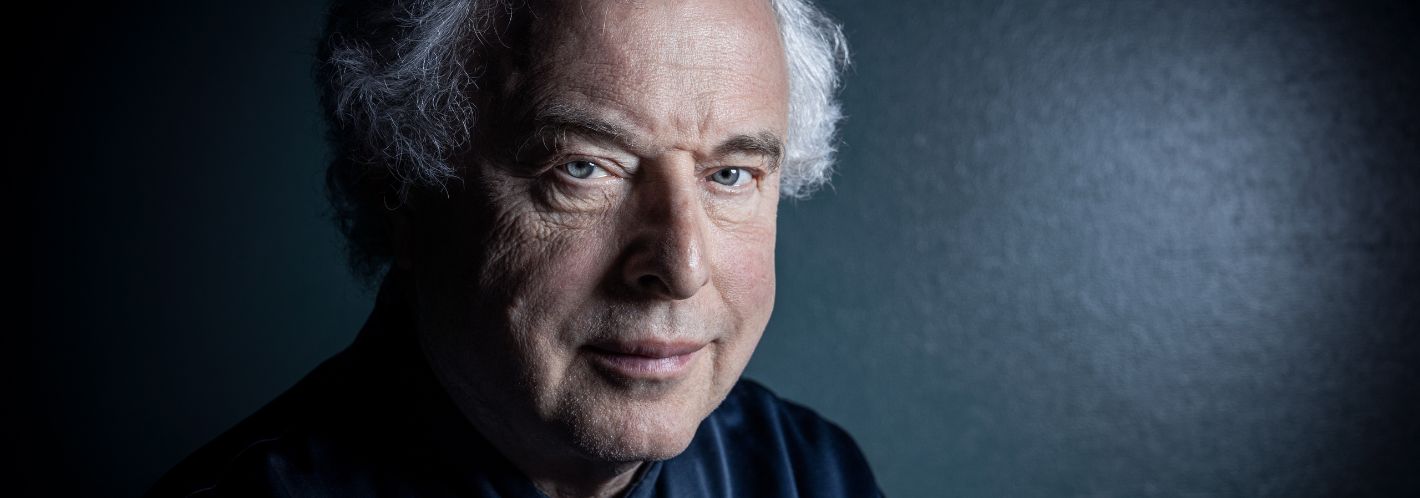
Sir András Schiff was born in Budapest in 1953. He received his first piano lessons at the age of five from Elisabeth Vadász. He later continued his studies at the Franz Liszt Academy in Budapest with Prof. Pál Kadosa, György Kurtág, and Ferenc Rados, as well as with George Malcolm in London.
Piano recitals have always been a central part of his artistic activities, particularly his cyclical performances of piano works by Bach, Haydn, Mozart, Beethoven, Schubert, Chopin, Schumann, and Bartók. Since the pandemic, he no longer announces the programs for his recitals in advance, instead selecting works on the evening of the concert to suit the instrument and the hall.
Sir András Schiff performs with most of the internationally important orchestras and conductors. He focuses on the performance of the piano concertos by Bach, Mozart, and Beethoven under his direction. In 1999, he founded Cappella Andrea Barca, a chamber orchestra composed of musician friends and soloists, with whom he has since worked closely as both conductor and soloist. He also enjoys a longstanding collaboration with the Chamber Orchestra of Europe. Since 1998, he has been the artistic director of the Omaggio a Palladio festival, held at the Teatro Olimpico in Vicenza with Cappella Andrea Barca.
In 2018, he accepted the invitation to become an Associate Artist of the Orchestra of the Age of Enlightenment, which met his growing interest in performing on historical keyboard instruments.
Sir András Schiff has been a passionate chamber musician since his youth. From 1989 to 1998, he directed the Musiktage Mondsee, a chamber music festival in Austria that gained significant international recognition. Together with Heinz Holliger, he was also the artistic director of the Ittinger Pfingstkonzerte at Kartause Ittingen, Switzerland, from 1995 to 2013.
Supporting young musicians is particularly close to his heart. He teaches piano and chamber music at the Kronberg Academy and the Barenboim-Said Academy and gives numerous masterclasses. In 2014, he founded the Building Bridges mentoring program, which provides long-term support for emerging pianists.
For 15 years, Sir András Schiff was an exclusive Decca artist; in celebration of his 70th birthday, the label released a box set containing all 78 albums he recorded for them. Since 1998, he has recorded exclusively for ECM, where his live recordings of Beethoven’s complete piano sonatas, performed at the Zurich Tonhalle, received the highest accolades. His album Geistervariationen, featuring compositions by Robert Schumann, won the 2012 International Classical Music Award in the category Solo Instrument Recording of the Year. A chamber music edition in collaboration with clarinetist and composer Jörg Widmann includes Brahms’s two clarinet sonatas, Op. 120, as well as Intermezzi for Piano, composed by Widmann and dedicated to Sir András Schiff. His most recent recordings include Brahms’s two piano concertos, performed on a historic Blüthner piano with the Orchestra of the Age of Enlightenment (2021), and a selection of J.S. Bach’s key works, played on a clavichord (2023).
In March 2017, his book Musik kommt aus der Stille (Music Comes Out of Silence) was published by Bärenreiter and Henschel. The book, which includes essays and conversations with Martin Meyer, explores Schiff’s artistic philosophy, playing techniques, interpretative methods, and professional experiences as a pianist and conductor. It has been translated into several languages and republished in 2024.
In the spring of 2011, Schiff made headlines when he publicly spoke out against alarming political developments in Hungary. In response to the insults and attacks he received from Hungarian nationalists, he decided to stop performing in his home country.
Sir András Schiff has received numerous international prizes and distinctions. In 2006, he was honoured with an honorary membership of the Beethoven-Haus Bonn for his outstanding achievements as a Beethoven interpreter. He has been the recipient of the Robert Schumann Prize of the City of Zwickau and the Order Pour le Mérite for Sciences and Arts since 2011. In 2012, he was awarded the Grand Cross of Merit with Star of the Federal Republic of Germany, the Wigmore Hall Medal in London for his 30 years of musical activity, and the Golden Mozart Medal of the International Mozarteum Foundation. In the same year, he was also appointed Special Supernumerary Fellow of Balliol College (Oxford, UK) and received the Royal Philharmonic Society's highest honour, the Gold Medal, in London. He received honorary doctorates from the University of Leeds in 2014 and the Royal College of Music in 2018. In 2013, he was knighted by Queen Elizabeth II, receiving the title Knight Bachelor for his services to music. In 2021, he was awarded the Antonín Dvořák Prize in Prague for his many years of promoting Czech composers through his numerous recordings and concert activities worldwide. In 2022, he received the Bach Medal of the City of Leipzig as one of the most important Bach interpreters of our time.
He has been an honorary citizen of the city of Vicenza since December 2014 and an honorary member of the Accademia Olimpica di Vicenza since 2016, from which he received the Lauro Olimpico in 2023 for his extraordinary contribution to the enhancement of Vicenza's artistic and cultural heritage. In March 2024, he was awarded the Una vita nella musica prize by the Teatro La Fenice in Venice. In January 2012, he was awarded the Golden Mozart Medal of the International Mozarteum Foundation. He has been an honorary member of the Wiener Konzerthaus since the same year.
In August 2023, at his 66th appearance at the Salzburg Festival, he was honoured with the Festival Pin with Rubies as an “essential artist who has shaped Festival history.” In June 2024, Sir András Schiff was awarded the Austrian Cross of Honour for Science and Art, First Class, and received the Bösendorfer Ring, which had previously been awarded to Wilhelm Backhaus and Paul Badura-Skoda.
source: Künstleragentur Dr. Raab & Dr. Böhm
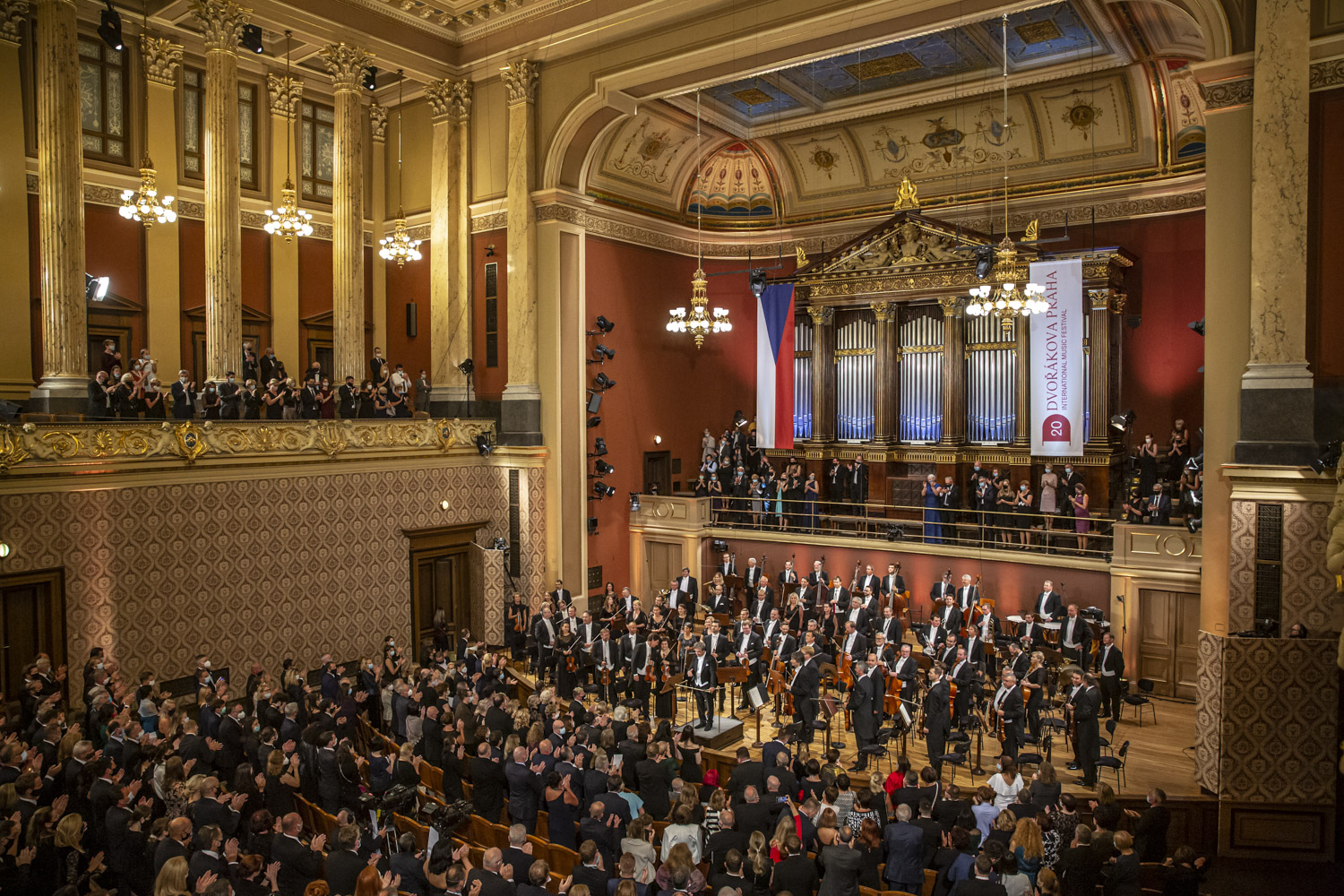
The Rudolfinum is one of the most important Neo-Renaissance edifices in the Czech Republic. In its conception as a multi-purpose cultural centre it was quite unique in Europe at the time of its construction. Based on a joint design by two outstanding Czech architects, Josef Zítek and Josef Schultz, a magnificent building was erected serving for concerts, as a gallery, and as a museum. The grand opening on 7 February 1885 was attended by Crown Prince Rudolph of Austria, in whose honour the structure was named. In 1896 the very first concert of the Czech Philharmonic Orchestra took place in the Rudolfinum's main concert hall, under the baton of the composer Antonín Dvořák whose name was later bestowed on the hall.