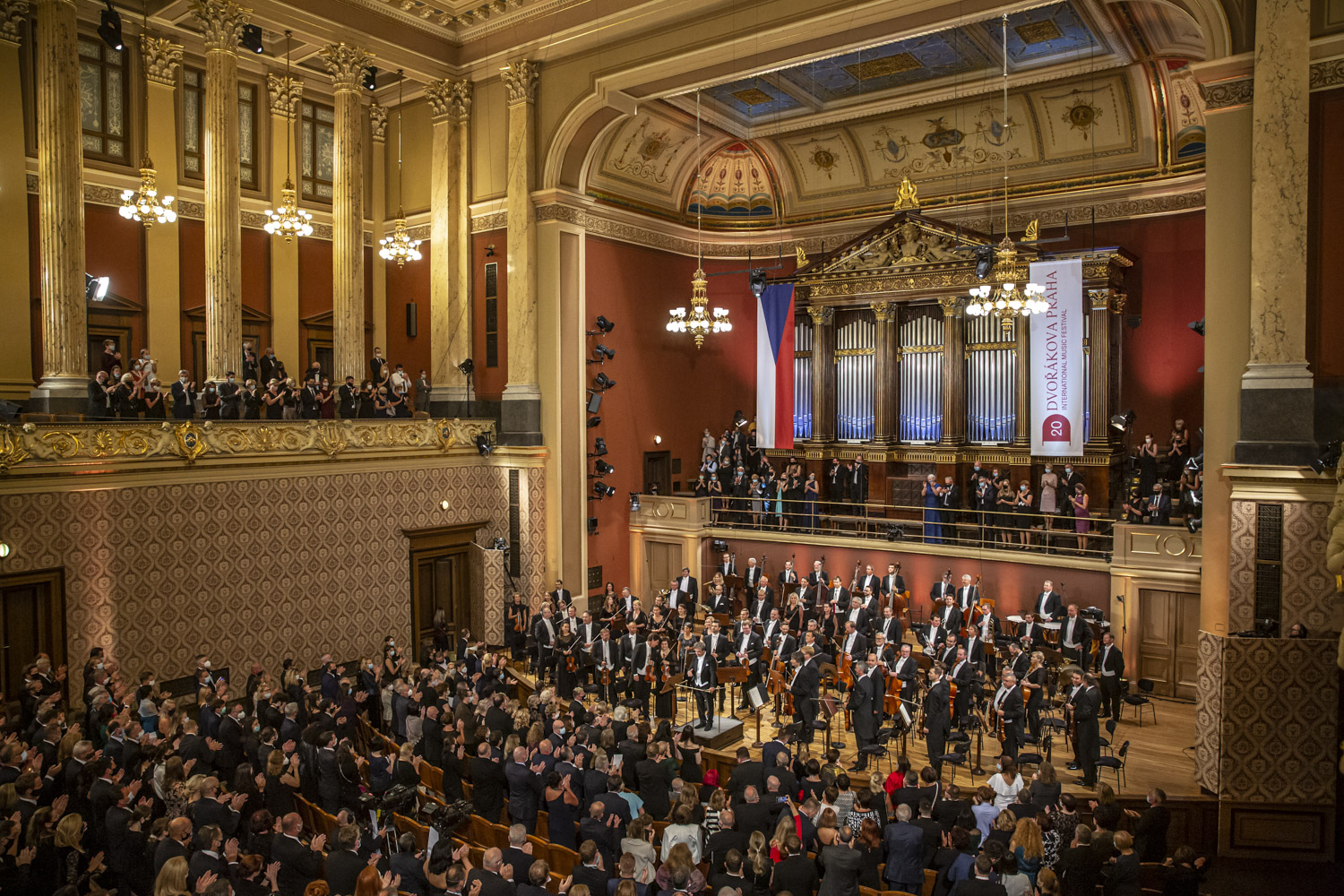
Sergei Rachmaninoff: Piano Concerto No. 3 in D Minor, Op. 30
Aaron Copland: Symphony No. 3
Russia and the USA are huge countries that are both widely geographically and politically separated, yet one single man brings their cultures together. Antonín Dvořák was able to exhibit a Slavic tendency towards Russian sources of inspiration while also absorbing and influencing America’s musical life. Similarly, Sergei Rachmaninoff and Aaron Copland encounter each other on the same programme. The former composer’s great Romantic passion is recast in his Piano Concerto No. 3 in D minor. The latter’s Symphony No. 3 helped define the typical sound of American music. Representing the spirit of Dvořák is the Czech Philharmonic, which still proudly claims the legacy of its first conductor. Israeli pianist Boris Giltburg thrilled the Dvořák Prague Festival public in 2019, when he played 13 Rachmaninoff preludes alongside Liszt’s complete Transcendental Etudes. Giltburg’s performance of Rachmaninoff’s concerto promises to be a fantastic experience, and the Czech Philharmonic will give noble expression to the atmosphere of the sonic image of the endless American plains. All of this will be heard under the baton of the orchestra’s principal guest conductor, Tomáš Netopil.
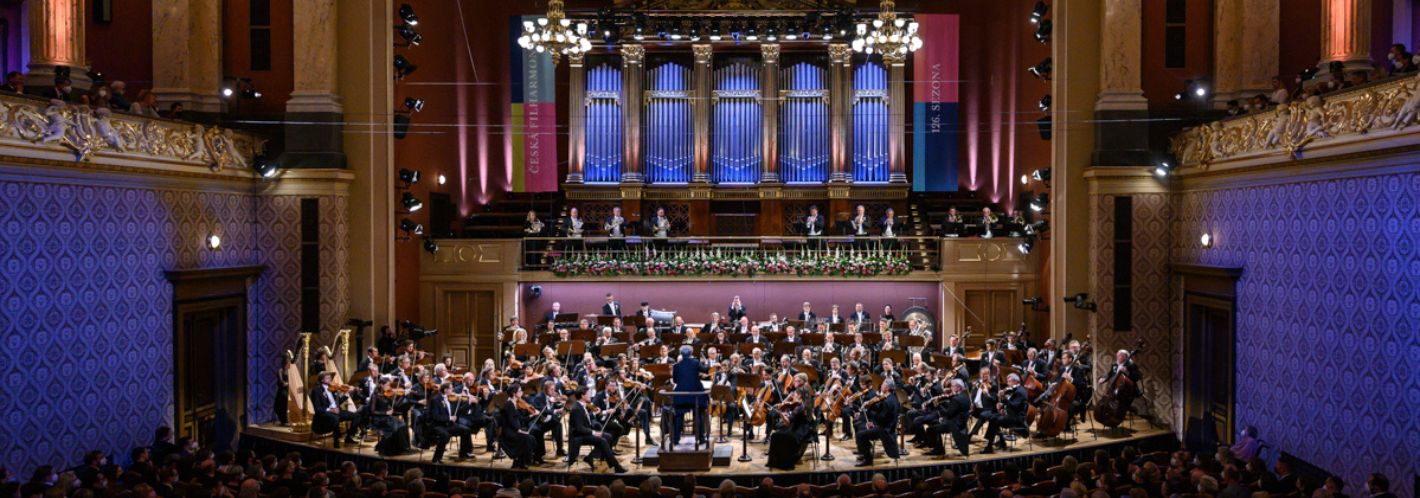
Named Gramophone’s Orchestra of the Year in 2024, the Czech Philharmonic is recognised as one of the world’s leading orchestras and remains the Czech Republic’s key cultural ambassador. Now in its 131st season, the orchestra combines a deep-rooted musical tradition with an international artistic outlook, expanding its profile through tours, residencies and recordings.
During the 2024 Year of Czech Music, the Czech Philharmonic and its Chief Conductor and Music Director Semyon Bychkov gave a three-day residency at New York’s Carnegie Hall. That same year saw the release of their recording of Smetana’s Má vlast (My Country), which went onto win the 2025 BBC Music Magazine Orchestral Award. In addition to Czech music, the orchestra’s long-standing relationship with composers such as Brahms, Tchaikovsky and Mahler has resulted in a series of benchmark recordings, including The Tchaikovsky Project (2019) and the first new cycle of Mahler symphonies in more than 40 years, released in 2026. The next release with Bychkov features Shostakovich’s Symphony Nos. 5 and 7.
The 131st season opens in Prague with Shostakovich’s Violin Concerto No. 1 featuring Artist-in-Residence Janine Jansen, alongside Dvořák’s Symphony No. 7. Touring highlights include the orchestra’s first visit in over 50 years to Sweden and Finland, a return to Lucerne Festival, and residencies in London, Vienna and Hamburg. At home, the Czech Philharmonic performs at the Rudolfinum in Prague and at leading Czech festivals including Dvořák Prague, Prague Spring, Smetana Litomyšl, and for the first time, Janáček Brno.
Repertoire this season with Bychkov includes Má vlast; works by Mussorgsky, Ravel, Adams, Strauss, Glanert and Britten; and a major focus on Rachmaninoff, presented both in Prague and on tour. Beethoven’s Ninth Symphony, performed with the Prague Philharmonic Choir, will mark the 200th anniversary of the composer’s death in 2027.
Principal Guest Conductors Simon Rattle and Jakub Hrůša both return this season. With Rattle, the orchestra presents music by Barber, Shostakovich, Debussy, Szymanowski and the Czech premiere of Composer-in-Residence Thomas Adès’s Aquifer. With Hrůša – appointed last year as the orchestra’s next Chief Conductor and Music Director (Renáta Kellnerová Chair) from the 2028/2029 season – they perform works by Strauss, Beethoven, Suk and a world premiere by Martin Smolka.
Guest conductors this season include Vasily Petrenko, Herbert Blomstedt, Elim Chan, Maxim Emilyanchev, and Daniel Harding, who closes the subscription season with the Accademia Nazionale di Santa Cecilia. Guest soloists include Yuja Wang, Behzod Abduraimov, Mao Fujita, Yunchan Lim, Seong-Jin Cho, Karen Gomyo, Radek Baborák and Kirill Gerstein.
The Czech Philharmonic’s distinguished history reflects the Czech Republic’s complex political past and its central European location. An early champion of the music of Martinů and Janáček, the Czech Philharmonic gave its first concert in 1896 with an all-Dvořák programme conducted by the composer itself.
Alongside its commitment to championing Czech composers, the orchestra’s belief in the power of music to transform lives remains a defining principle. The Czech Philharmonic Youth Orchestra, Orchestral Academy, and Jiří Bělohlávek Prize for young musicians, form part of the orchestra’s education strategy which engages with more than 400 schools. An inspirational music and song programme led by Ida Kelarová continues to support social inclusion by giving voice to Romany communities through music.
source: Česká filharmonie
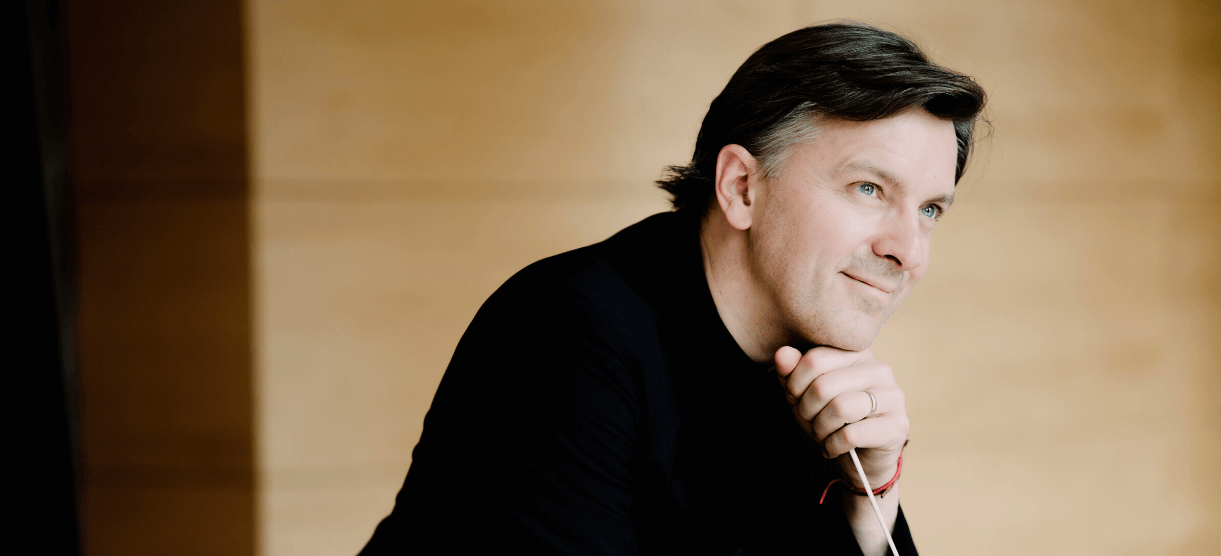
Chief Conductor and Music Director of the Prague Symphony Orchestra (FOK) since September 2025
Since the start of the 2025/2026 season, Tomáš Netopil has held the post of chief conductor and music director of the Prague Symphony Orchestra (FOK). Between 2009 and 2012, he was chief conductor of the National Theatre Opera in Prague, and from 2013 to 2023 he served as general music director of the Aalto Musiktheater and Philharmonie Essen. From 2018 to 2024, he was principal guest conductor of the Czech Philharmonic.
This season, Tomáš Netopil has conducted a trio of Mozart operas: La clemenza di Tito at the Grand Théâtre de Genève, The Magic Flute at the New National Theatre Tokyo, and Don Giovanni at the Cologne Opera. He led the Czech Philharmonic’s New Year’s Concert at Prague’s Rudolfinum in a live television broadcast. He will present a broad array of symphonic repertoire during engagements with the Oslo Philharmonic, Antwerp Symphony Orchestra, Kuopio Symphony Orchestra, Sydney Symphony Orchestra, Hong Kong Sinfonietta and the Accademia Nazionale di Santa Cecilia, among others. He will also return to the Orchestre Philharmonique de Monte-Carlo this season and make his debut with the Orchestre National des Pays de la Loire. Continuing his successful collaboration with the legendary Concentus Musicus Wien, he will perform Mozart’s Requiem at this year’s Prague Spring Festival.
Among Tomáš Netopil’s notable operatic collaborations, in addition to numerous productions at the Aalto Musiktheater Essen, are frequent appearances with the Sächsische Staatsoper Dresden, Vienna State Opera, Dutch National Opera and the Grand Théâtre de Genève.
On the concert stage, he has conducted many world-renowned orchestras, including, in addition to the Essen Philharmonic, Czech Philharmonic and the Prague Symphony Orchestra, the Orchestre National de France, Vienna Symphony Orchestra, Orchestre Philharmonique de Monte-Carlo, Orchestra dell’Accademia Nazionale di Santa Cecilia, BBC Symphony Orchestra, Sinfonia Varsovia, Tonhalle-Orchester Zürich, Orchestre de Paris, London Philharmonic Orchestra, Netherlands Radio Philharmonic Orchestra and the Orchestra RAI Torino.
Tomáš Netopil is the artistic director of the International Summer Music Academy Kroměříž, which he founded in 2018.
He studied violin at the P. J. Vejvanovský Conservatory in Kroměříž and conducting at the Academy of Performing Arts in Prague, continuing his studies at the Royal Academy of Music in Stockholm and the Aspen Music Festival and School in the USA, where he won the main prize of the American Academy of Conducting in both 2003 and 2004. He remains a regular guest conductor there. In 2002, he won the Sir Georg Solti Conductors’ Competition in Frankfurt.
His most recent recording — an album of Smetana opera arias with tenor Pavel Černoch and the Czech Philharmonic — was nominated for the 2024 Anděl Awards.
source: The Prague Symphony Orchestra (FOK)
photo © Marco Borggreve
The Moscow-born, Israeli pianist is lauded across the globe as a deeply sensitive, insightful and compelling interpreter. Critics have praised his “singing line, variety of touch and broad dynamic palette capable of great surges of energy” (Washington Post) as well as his impassioned, narrative-driven approach to performance.
In recent years Giltburg has engaged in a series of in-depth explorations of major composers. To celebrate the Beethoven anniversary in 2020 he embarked upon a unique project to record and film all 32 of Beethoven’s piano sonatas across the year. He also recorded the complete concerti with Vasily Petrenko and the Royal Liverpool Philharmonic Orchestra on Naxos.
In 2021-2023 Giltburg explores the complete works of Ravel, performing the solo works across Bozar, Flagey and the Amsterdam Musiekgebouw, and the whole cycle at Wigmore (including the Violin Sonatas with Alina Ibragimova). He also plays Ravel’s concerti with the Orchestre National de France/Macelaru at Bozar, Brussels Philharmonic/Prieto at Flagey, and Residentie Orkest/Bihlmaier at the Concertgebouw.
Widely recognized as a leading interpreter of Rachmaninoff, Giltburg completes his recording of Rachmaninoff’s solo works in 2023 and releases the last disc in his acclaimed concerto cycle. Giltburg also plays Rachmaninoff concerti with Sakari Oramo and the BBC Symphony at the Barbican, Tomáš Netopil and the Czech Philharmonic, Nicholas Collon and the Finnish Radio Symphony, and Brussels Philharmonic and Giancarlo Guerrero at Flagey.
Giltburg regularly plays recitals in the world’s most prestigious halls, including the Amsterdam Concertgebouw, Carnegie Hall, Hamburg Elbphilharmonie, Wiener Konzerthaus and London Southbank Centre. He has worked with Philharmonia Orchestra, London Philharmonic, Czech Philharmonic, Oslo Philharmonic, Dresden Philharmonic, NHK Symphony and at the BBC Proms. In 21/22 he debuted at the Santa Cecilia di Roma with Kirill Petrenko.
Giltburg’s collaboration with Naxos began in 2015, winning the Opus Klassik award for Best Soloist Recording (Rachmaninoff concerti and Etudes Tableaux) and a Diapason d’Or (Shostakovich concerti and his own arrangement of Shostakovich’s 8th String Quartet). He also won a Gramophone Award for the Dvorak Piano Quintet on Supraphon with the Pavel Haas Quartet, as well as a Diapason d’Or for their latest joint release, the Brahms Piano Quintet.
Giltburg feels a strong need to engage audiences beyond the concert hall. His blog “Classical music for all” is aimed at a non-specialist audience, and he complements it with articles in publications such as Gramophone, BBC Music Magazine, Guardian, Times and Fono Forum. During the lockdown period in spring 2020, Giltburg regularly streamed live performances and masterclasses from home, with over 1 million views.
Source: Intermusica

The Rudolfinum is one of the most important Neo-Renaissance edifices in the Czech Republic. In its conception as a multi-purpose cultural centre it was quite unique in Europe at the time of its construction. Based on a joint design by two outstanding Czech architects, Josef Zítek and Josef Schultz, a magnificent building was erected serving for concerts, as a gallery, and as a museum. The grand opening on 7 February 1885 was attended by Crown Prince Rudolph of Austria, in whose honour the structure was named. In 1896 the very first concert of the Czech Philharmonic Orchestra took place in the Rudolfinum's main concert hall, under the baton of the composer Antonín Dvořák whose name was later bestowed on the hall.